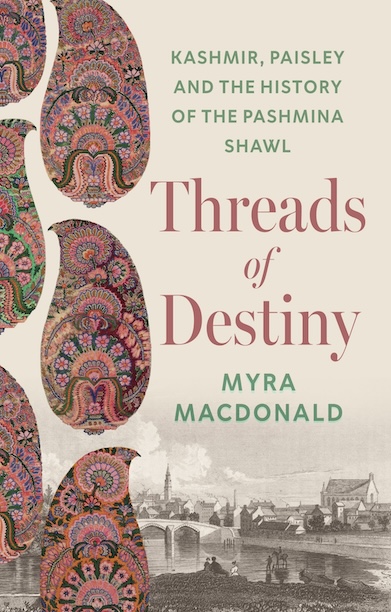
Threads of Destiny
Kashmir, Paisley and the History of the Pashmina Shawl
A surprising parallel history of Scotland and British India, tied together by the pashmina shawl.
Description
Seventeenth-century Kashmir was renowned for its beautiful pashmina shawls, woven from the fine, warm wool of the Tibetan mountain goat. Paisley was a provincial Scottish town where weavers produced plain cloth in homespun wool and flax. But by the 1800s, these Scottish artisans could imitate Kashmiri shawls so adeptly that their characteristic swirling colours and tear-drop motifs became known by a new name: ‘the Paisley pattern’.
Myra MacDonald traces the rise of Paisley’s handloom weavers through the British Empire and Industrial Revolution—and the corresponding slide in fortunes of their Kashmiri counterparts. While Scotland’s textile trade flourished, spurred by British economic growth and innovation, in Kashmir, foreign conquest and the relentless pursuit of pashm wool provoked political intrigue and war. Then, as the nineteenth century unfolded, handloom weavers on both continents found their fates unexpectedly united, as world-altering industrialisation trampled traditional handicrafts underfoot.
This is a riveting human story of empire, fashion and technology—and of the intertwined destinies of two peoples thousands of miles apart.
Table of contents
Introduction
Chapter One: The Hair Of The Goat
Chapter Two: Witches And Weavers
Chapter Three: Of Mules And Men
Chapter Four: From Witches To Riches
Chapter Five: Mission To Tibet
Chapter Six: Fashion And Foreign Conquest
Chapter Seven: The Golden Age Of Weaving
Chapter Eight: Moorcroft
Chapter Nine: Poets And Pioneers
Chapter Ten: Kashmir Under The Sikhs
Chapter Eleven: Wool To Die For
Chapter Twelve: The Sma’ Shot
Chapter Thirteen: The Stampede
Chapter Fourteen: Collapse And Its Aftermath
Conclusion
Bibliography
Index
Author(s)

Myra MacDonald is a journalist and author specialising in South Asian politics, history and security. Her previous books include the acclaimed Defeat is an Orphan: How Pakistan Lost the Great South Asian War, and White as the Shroud: India, Pakistan and War on the Frontiers of Kashmir, also published by Hurst.
Related books