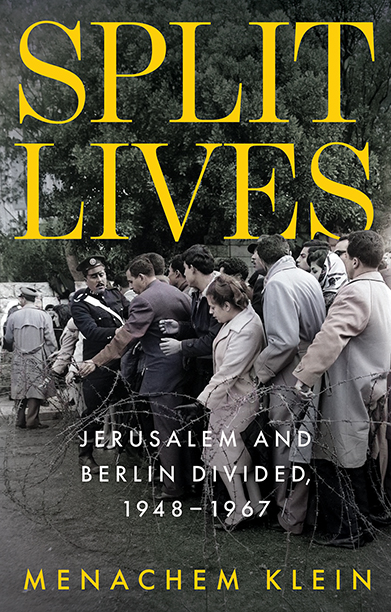
Split Lives
Jerusalem and Berlin Divided, 1948 – 1967
Drawing parallels with Cold War Berlin, Split Lives examines the divided city of Jerusalem to show the global context of the Israeli–Arab conflict.
Description
This is the first comprehensive social history of Jerusalem between the 1948 and Six-Day wars—from the establishment of an international border cutting through the city for the first time in history until its reunification by arms in June 1967. Throughout his narrative, Menachem Klein draws parallels with Berlin, which was first partitioned by the Allies and later bisected by the Berlin Wall, highlighting Jerusalem’s uniqueness while also reframing the Israeli–Arab conflict within a global context.
World War Two and the 1948 War ended the short life of cosmopolitan Jerusalem. The latter was born in the twilight days of the multicultural Ottoman Empire and replaced by two mono-national cities: Palestinian-Jordanian and Israeli-Jewish, located at the edge of two young, poor and internationally inconsequential states. Mixed neighbourhoods became homogeneous, and refugees and immigrants filled the streets of the divided cities. Contrary to popular belief, this was not an insignificant period—it was a formative era whose effects on Israeli–Palestinian relations resonate to this day.
Klein focuses on daily life in Jerusalem: how its residents shaped the segregated space and made it their own. His compelling narrative brings back to life the two cities as their inhabitants experienced them.
Author(s)
Menachem Klein is Professor Emeritus in Political Science at Bar-Ilan University. Formerly a fellow at St Antony’s College, University of Oxford; a visiting professor at MIT; and a visiting research fellow at King’s College London, his books with Hurst include Lives in Common, a New Republic Book of the Year.
Related books