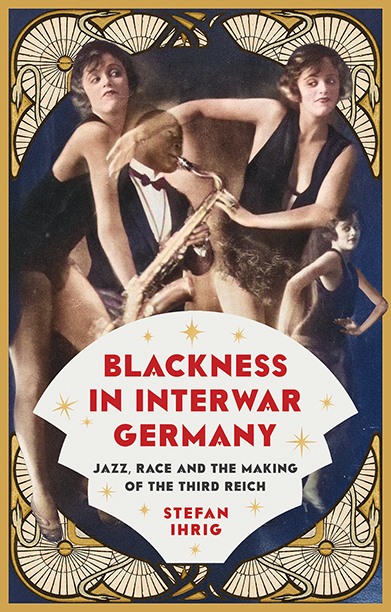
Blackness in Interwar Germany
Jazz, Race and the Making of the Third Reich
The first comprehensive account of Blackness in Germany, spanning the late Empire, the Roaring Twenties and the aftermath of World War Two.
Description
Germany’s past in relation to Blackness is often dismissed as peripheral: its colonial enterprise lasted merely three decades, and, until the end of World War Two, the Black population in Germany was small. Yet debates about Blackness, especially in the 1920s, were part of wider discussions in which social and political problems were articulated through race—problems the Nazis later claimed to have answers for.
Through a deep exploration of Germany’s imperial experiences in Africa, Stefan Ihrig reveals that ideas about Blackness played a significant role in German history, even when there were few Black people in Germany or, as under Hitler, Africa largely fell outside the regime’s predatory gaze. He examines the Weimar period, when Blackness served as a symbol—and to some extent the embodiment—of the Jazz Age. And he analyses how anxieties about racial mixing, the New Woman and the perceived corrupting influence of a Black and American modernity fuelled the cultural backlash in the years up to Hitler’s appointment as Chancellor. As Ihrig uncovers, anti-Blackness was a central theme in Nazi discourse.
This illuminating investigation is both a prehistory of the Third Reich and a history of an important, often overlooked dimension of modern Germany.
Table of contents
Intro
Backgrounds
1. Questions of empire and race
2. The African elections of 1907
3. The ‘bastard’ question of 1912
“Shame”
4. The ‘Black Watch on the Rhine’
The Roaring German Twenties
5. The ‘new woman’ and new sexual mores
6. The Jazz Age, Blacks, and the New Woman
7. Jazz and the late Weimar culture wars
8. The Nazis, reverse colonization, and Blackness
The Third Reich
9. Blackness and the Third Reich
10. Blacks under the Swastika
War & Postwar
11. BaRles, massacres, internment
12. The instant return of Blackness
Conclusion
Bibliography
Index
Reviews
‘Stefan Ihrig has done it again. This is another scholarly tour de force, showing that we have long been looking at the colonial legacy from the wrong angle in trying to explain the Shoah and the war of extermination in the East.’ — Thomas Weber, author of Becoming Hitler: The Making of a Nazi
‘A cogently written history of the meanings and afterlives of Blackness and anti-Blackness from the Wilhelmine to the Nazi periods. This is an important account that centres Blackness in and beyond the German nation.’ — Tiffany N. Florvil, author of Mobilizing Black Germany
‘An important cultural history of anti-Black racism and the discourse around jazz culture in the Weimar era. Drawing on an impressively broad study of popular journals, Ihrig shows how anti-Blackness was deeply intertwined with anti-feminism and antisemitism. Blackness in Interwar Germany demonstrates that anti-Black racism was no mere “also” feature of the Nazi worldview, but a core element of their racist ideology.’ — Jonathan Skolnik, author of Jewish Pasts, German Fictions
‘Stefan Ihrig’s thorough, elegantly written book synthesises the literature on Blackness in Weimar and Nazi Germany while offering pertinent arguments of the author’s own. By researching the contemporary press, he draws connections to antifeminism and antisemitism and contextualises anti-black racism within German culture.’ — Moritz Föllmer, author of Culture in the Third Reich
‘A fascinating history of largely overlooked Blackness in the Weimar Republic, offering profound insights into Nazi-Germany’s Aryan obsession.’ — Henning Melber, Director Emeritus of the Dag Hammarskjöld Foundation, and author of The Long Shadow of German Colonialism
Author(s)
Stefan Ihrig is a historian of German and Turkish history. His book Atatürk in the Nazi Imagination has been translated into five languages, and Justifying Genocide won the 2017 Dr. Sona Aronian Book Prize for Excellence in Armenian Studies. He divides his time between the Eastern Mediterranean and northern France.
FAQs
Frequently Asked Questions
What is "Blackness in Interwar Germany" about?
Germany’s past in relation to Blackness is often dismissed as peripheral: its colonial enterprise lasted merely three decades, and, until the end of World War Two, the Black population in Germany was small. Yet debates about Blackness, especially in the 1920s, were part of wider discussions in which social and political problems were articulated through race—problems the Nazis later claimed to have answers for.
Through a deep exploration of Germany’s imperial experiences in Africa, Stefan Ihrig reveals that ideas about Blackness played a significant role in German history, even when there were few Black people in Germany or, as under Hitler, Africa largely fell outside the regime’s predatory gaze. He examines the Weimar period, when Blackness served as a symbol—and to some extent the embodiment—of the Jazz Age. And he analyses how anxieties about racial mixing, the New Woman and the perceived corrupting influence of a Black and American modernity fuelled the cultural backlash in the years up to Hitler’s appointment as Chancellor. As Ihrig uncovers, anti-Blackness was a central theme in Nazi discourse.
This illuminating investigation is both a prehistory of the Third Reich and a history of an important, often overlooked dimension of modern Germany.
Who wrote "Blackness in Interwar Germany"?
"Blackness in Interwar Germany" was written by Stefan Ihrig.
Stefan Ihrig is a historian of German and Turkish history. His book Atatürk in the Nazi Imagination has been translated into five languages, and Justifying Genocide won the 2017 Dr. Sona Aronian Book Prize for Excellence in Armenian Studies. He divides his time between the Eastern Mediterranean and northern France.
What is the Table of Contents for "Blackness in Interwar Germany"?
Intro
Backgrounds
1. Questions of empire and race
2. The African elections of 1907
3. The ‘bastard’ question of 1912
“Shame”
4. The ‘Black Watch on the Rhine’
The Roaring German Twenties
5. The ‘new woman’ and new sexual mores
6. The Jazz Age, Blacks, and the New Woman
7. Jazz and the late Weimar culture wars
8. The Nazis, reverse colonization, and Blackness
The Third Reich
9. Blackness and the Third Reich
10. Blacks under the Swastika
War & Postwar
11. BaRles, massacres, internment
12. The instant return of Blackness
Conclusion
Bibliography
Index
Related books