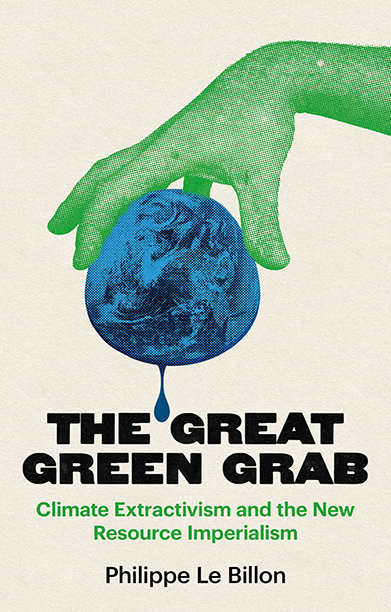
The Great Green Grab
Climate Extractivism and the New Resource Imperialism
Reveals how decarbonisation became a global scramble for minerals, land and power.
Description
The spiralling climate crisis demands a rapid shift away from fossil fuels. But most current approaches to decarbonisation rely on a dramatic expansion of resource extraction–exacerbating environmental degradation and deepening global inequalities. This is the paradox of the so-called green transition.
Philippe Le Billon offers a critical examination of the material and political underpinnings of climate change mitigation. Drawing on insights from political ecology, critical geography and environmental justice, he interrogates the rise of ‘climate extractivism’: the opening up of new resource frontiers and the construction of infrastructure megaprojects in the name of sustainability. From artisanal cobalt mining in the DRC to rare-earth geopolitics, and from biofuel plantations to deep-sea and space mining, he reveals how green growth agendas frequently reproduce colonial structures, social injustice and patterns of dispossession.
Scrutinising proposed solutions such as geoengineering, carbon offsets, circular economy schemes and degrowth, Le Billon shows that many climate adaptation strategies remain tethered to considerations of economic growth and geopolitical competition. Rather than rejecting the urgency of climate transition, The Great Green Grab calls for a fairer, post-extractive future—one that wholly reshapes how we produce and consume energy, and fosters a more democratic, cooperative relationship with the earth.
Table of contents
A Note on Misuse
Preamble
1. Introduction
PART I: CLIMATE CRISIS AND THE TRANSITION IMPERATIVE
2. Climate Crisis, Green Transition, and Extractivism
3. The Extraction Gap
4. Green Rush Conflicts
PART II: BEYOND THE BRIGHT SIDE OF GREEN
5. Cobalt: Digging Pits With Bare Hands
6. Rare Earths: Melting Hills Beyond the Border
7. Lithium: Evaporating Water in Deserts
8. Deepsea Mining: Scraping the Bottom
9. Outerspace Mining: Capitalizing on the Heavens
PART III: RENEWABLE EXTRACTIVISM
10. Feeding the Machine: Biomass and Agro-Extractivism
11. Damming the Flow: Hydropower and Water Extractivism
12. Shining Bright: Solar Power 1
3. Winding Up: Wind Power
14. Greening Nukes: Nuclear Energy
PART IV: BACK TO EARTH
15. Carbon, Sunshine, and Geoengineering
16. Offsetting Extraction
17. Ending Fossil Fuel Extractivism
18. Greening Extraction?
19. Degrowth and Decolonizing Extractivism
20. Conclusion
Notes
Index
Reviews
‘A tour de force, ruthless in its critique of the colonial contours of the energy transition, yet equally relentless in its search for socially just, ecologically rational and politically durable pathways to an actually greener future. Impressive.’ — Thea Riofrancos, author of Extraction: The Frontiers of Green Capitalism
‘If you are wondering why so many green transition promises do not seem to get us closer to a more sustainable planet, read this fantastic book. Le Billon provides a cutting-edge overview of the problems but also shows what a post-extractivist, just transition could look like.’ — Bram Büscher, Chair of the Sociology of Development and Change Group, Wageningen University, and author of The Truth About Nature
‘What a necessary book this probing study of neoliberal “climate extractivism” and its often violent impact on the already dispossessed is. After reading it, you’ll never again talk mindlessly and uncritically of “green growth” or the “green transition”.’ — Anne Karpf, author of How Women Can Save the Planet
‘This book tells the story of the new extractive frontiers shaped by the rush for clean energy transitions. A truly inconvenient truth that every environmentalist must be confronted with.’ — Giorgos Kallis, ICREA Professor, Institute of Environmental Science and Technology, Universitat Autònoma de Barcelona, and co-author of The Case for Degrowth
‘Le Billon pinpoints an uncomfortable paradox: how the green ideal of decarbonisation is implicated in new modes of resource extraction. With up-to-the-minute research, he tackles a dazzling array of issues, from the geopolitics of rare earth minerals to carbon offsets to the greening of nuclear energy.’ — Rob Nixon, Thomas A. and Currie C. Barron Family Professor in Humanities and the Environment, Princeton University, and author of Slow Violence and the Environmentalism of the Poor
‘A well-documented, comprehensive view of the state of the “energy transition” and its key debates and challenges. A compelling and provocative book.’ — Javiera Barandiarán, Associate Professor of Global Studies, University of California, Santa Barbara, and author of Living Minerals: Nature, Trade, and Power in the Race for Lithium
Author(s)
Philippe Le Billon is a professor with the Department of Geography and the School of Public Policy and Global Affairs at the University of British Columbia. He holds a PhD in Geography from the University of Oxford, and was a Fulbright Research Chair at UC Berkeley, a Scholar at the Institute for Advanced Studies in Princeton, a CARE Climate Leadership Fellow at Sciences Po Paris, and held positions at the Overseas Development Institute and the International Institute for Strategic Studies. A political ecologist working on the linkages between environment, development and security, he is the author of Wars of Plunder: Conflicts, Profits and the Politics of Resources (also published by Hurst); co-author of Oil; and co-editor of Environmental Defenders: Deadly Struggles for Life and Territory.
FAQs
Frequently Asked Questions
What is "The Great Green Grab" about?
The spiralling climate crisis demands a rapid shift away from fossil fuels. But most current approaches to decarbonisation rely on a dramatic expansion of resource extraction--exacerbating environmental degradation and deepening global inequalities. This is the paradox of the so-called green transition.
Philippe Le Billon offers a critical examination of the material and political underpinnings of climate change mitigation. Drawing on insights from political ecology, critical geography and environmental justice, he interrogates the rise of 'climate extractivism': the opening up of new resource frontiers and the construction of infrastructure megaprojects in the name of sustainability. From artisanal cobalt mining in the DRC to rare-earth geopolitics, and from biofuel plantations to deep-sea and space mining, he reveals how green growth agendas frequently reproduce colonial structures, social injustice and patterns of dispossession.
Scrutinising proposed solutions such as geoengineering, carbon offsets, circular economy schemes and degrowth, Le Billon shows that many climate adaptation strategies remain tethered to considerations of economic growth and geopolitical competition. Rather than rejecting the urgency of climate transition, The Great Green Grab calls for a fairer, post-extractive future—one that wholly reshapes how we produce and consume energy, and fosters a more democratic, cooperative relationship with the earth.
Who wrote "The Great Green Grab"?
"The Great Green Grab" was written by Philippe Le Billon.
Philippe Le Billon is a professor with the Department of Geography and the School of Public Policy and Global Affairs at the University of British Columbia. He holds a PhD in Geography from the University of Oxford, and was a Fulbright Research Chair at UC Berkeley, a Scholar at the Institute for Advanced Studies in Princeton, a CARE Climate Leadership Fellow at Sciences Po Paris, and held positions at the Overseas Development Institute and the International Institute for Strategic Studies. A political ecologist working on the linkages between environment, development and security, he is the author of Wars of Plunder: Conflicts, Profits and the Politics of Resources (also published by Hurst); co-author of Oil; and co-editor of Environmental Defenders: Deadly Struggles for Life and Territory.
What is the Table of Contents for "The Great Green Grab"?
A Note on Misuse
Preamble
1. Introduction
PART I: CLIMATE CRISIS AND THE TRANSITION IMPERATIVE
2. Climate Crisis, Green Transition, and Extractivism
3. The Extraction Gap
4. Green Rush Conflicts
PART II: BEYOND THE BRIGHT SIDE OF GREEN
5. Cobalt: Digging Pits With Bare Hands
6. Rare Earths: Melting Hills Beyond the Border
7. Lithium: Evaporating Water in Deserts
8. Deepsea Mining: Scraping the Bottom
9. Outerspace Mining: Capitalizing on the Heavens
PART III: RENEWABLE EXTRACTIVISM
10. Feeding the Machine: Biomass and Agro-Extractivism
11. Damming the Flow: Hydropower and Water Extractivism
12. Shining Bright: Solar Power 1
3. Winding Up: Wind Power
14. Greening Nukes: Nuclear Energy
PART IV: BACK TO EARTH
15. Carbon, Sunshine, and Geoengineering
16. Offsetting Extraction
17. Ending Fossil Fuel Extractivism
18. Greening Extraction?
19. Degrowth and Decolonizing Extractivism
20. Conclusion
Notes
Index
Related books
