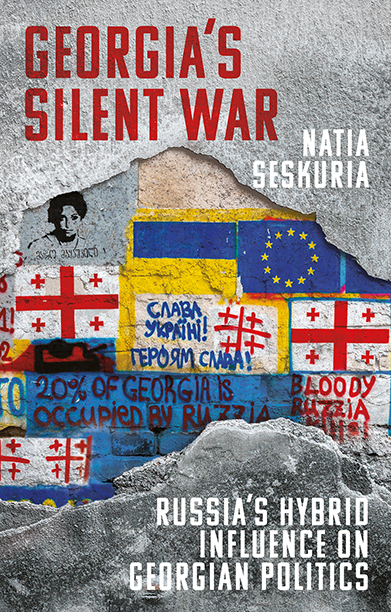
Georgia’s Silent War
Russia’s Hybrid Influence on Georgian Politics
Part of the New Perspectives on Eastern Europe and Eurasia seriesFrom the Rose Revolution to Ukraine today, an in- depth analysis of Russia’s strategy toward Georgia— and the story of a war that never truly ended.
Description
Fourteen years before Putin launched a full-scale war against Ukraine, he waged a brief five-day war with Georgia. For Moscow, the 2008 war was an opportunity to punish its neighbour—for pursuing European and Euro-Atlantic aspirations—as well as to send a signal to Ukraine. Once the dust of war settled, international focus shifted away from Georgia. Yet, Putin’s aims remained firm, and the conflict turned into a silent war, with Russian intervention persisting below the threshold of military escalation.
From independence to the present day, Natia Seskuria examines how conflict with Russia has shaped modern Georgian politics and foreign policy, and considers what ‘war by other means’ entails in Georgia’s case. Drawing on sources in Georgian, Russian and English, she explores the country’s dilemma: pursuing its foreign policy ambitions while constrained by geographic proximity to Russia.
This comprehensive analysis of political developments in post-independence Georgia traces the evolution of Georgian statehood and the growing sophistication of Russia’s coercive strategy. Seskuria’s nuanced and probing account centres Georgian agency, and exposes the mechanisms of Russian interference and influence.
Author(s)

Natia Seskuria is Associate Fellow at London’s Royal United Services Institute; Visiting Fellow at Harvard University; and the founder of a Tbilisi-based think tank, the Regional Institute for Security Studies. She advises various governments on international security issues, regularly appears on the BBC and CNN, and writes for Foreign Policy.
Related books