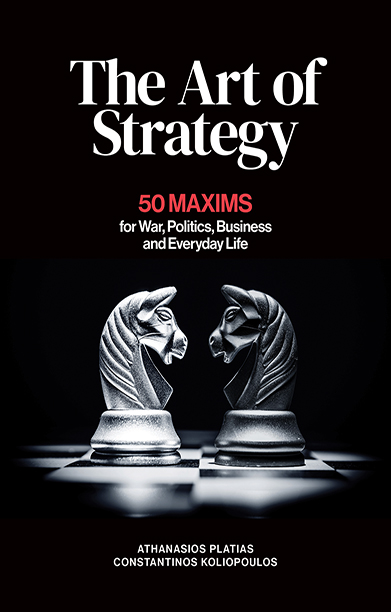
The Art of Strategy
50 Maxims for War, Politics, Business and Everyday Life
Drawing on examples from sport, diplomacy, business and more, the authors explore how strategic thinking can guide clear-sighted decision-making.
Description
From politicians seeking re-election, to statespeople craving spheres of influence, to business executives, military generals and sports coaches, we all employ strategy in our day-to-day activities. Strategic treatises on the art of war, politics or leadership have a long history, including those by Thucydides, Xenophon, Kautilya, Machiavelli and Clausewitz; yet, while recent decades have seen the proliferation of books on business strategy, there has still been no single volume, ancient or modern, combining all strands of the human strategic experience—until now.
The Art of Strategy encapsulates and conveys the logic of strategy in easily accessible prose, and applies it to virtually every form of human endeavour. It builds upon the existing strategic wisdom produced by the great masters to present a holistic theory of strategy that is relevant to practice: a sprightly yet sober analysis of fifty maxims, drawing on examples from chess to psychology.
Platias and Koliopoulos offer the reader a guide to strategic behaviour in all areas of life, while at the same time building a comprehensive theory of victory. They provide a framework that helps the reader to understand the nature of strategy, to think strategically, and to act strategically—and successfully.
Table of contents
Introduction
PART 1: THE GENERAL CHARACTERISTICS OF STRATEGY
Chapter 1. Strategy is immutable and universal
Chapter 2. Strategy can make the difference between victory and defeat
Chapter 3. There are no one-size-fits-all recipes in strategy
Chapter 4. The time factor operates at every level of strategy
Chapter 5: Strategy has limits: Some strategic problems are insoluble
PART 2: THE STRATEGIC PLAYER IN A COMPETITIVE ENVIRONMENT
Chapter 6. Do not depend on the enemy’s not coming, but on your readiness to face him if he comes
Chapter 7. Rely on your own power as much as you can
Chapter 8. War tests every aspect of your organization
Chapter 9. Leadership is a force multiplier—but also a force divider
Chapter 10. In the short term, rely on your strengths; in the long term, eliminate your weaknesses
Chapter 11. People do not walk on air: Geography sets the strategic context
Chapter 12. The ideological and the social environment are at least as important as the physical environment
Chapter 13. The “how” bounds the “what”: Technology influences strategy
Chapter 14. Intelligence is the eyes and ears of strategic players
Chapter 15. Help yourself: Shape the environment
PART 3: STRATEGIC CONTEST WITH SPECIFIC OPPONENTS
Chapter 16. What do you want to achieve?
Chapter 17. Can you actually do it?
Chapter 18. Conflict does not occur through violent means alone
Chapter 19. War and peace often coexist
Chapter 20. The opponent has a strategy, too 2
Chapter 22. Do not appease (rough) equals
Chapter 23. Strength diminishes as it moves away from its source
Chapter 24. Learn how to manage crises
Chapter 25. Alliances may save you; they may also entrap you
Chapter 26. The way others see you is, at least in the short term,
more important than the way you really are
Chapter 27. Prudence is perhaps the highest strategic virtue
Chapter 28. The home front is the cornerstone of your strategy
Chapter 29. You be a grindstone and the opponent an egg
Chapter 30. Economy is the basis of strategy
Chapter 31. Every war must end, and you had better figure out how
Chapter 32. Choose the place, the time, and the way of conflict
Chapter 33. Let others do the dirty work 158
Chapter 34. The opponent is not always rational—or so it seems to us
Chapter 35. Turn your enemy into a friend: Find the common interest wherever it exists
PART 4: EXECUTING STRATEGY
Chapter 36. Concentrate force and effort where it is important,
save force and effort where it is not
Chapter 37. “Who is in charge here?”: Unity of command and effort
Chapter 38. Nothing will happen as planned
Chapter 39. One who does not risk anything, risks everything
Chapter 40. War takes a thousand forms; do not take it for something that it is not
Chapter 41. Everything is decided by battle—even if a battle does not take place
Chapter 42. There is one strategy, but many strategies
Chapter 43. Successive tactical wins may or may not lead to strategic victory
Chapter 44. All strategy is based on deception, and the child of deception is surprise
Chapter 45. When stronger, win; when weaker, do not lose
Chapter 46. Physical destruction and psychological control are the two poles of victory
Chapter 47. Morale works miracles, but in the long run, mass prevails
Chapter 48. Without logistics, there is no strategy
Chapter 49. Success breeds success: Learn to exploit the snowball effect
Chapter 50. The marathon runner defeats the sprinter: The importance of strategic resilience
Epilogue: Theory and practice
Notes
Index
Reviews
‘The Art of Strategy arrives at precisely the right moment—when geopolitical fractures, technological disruption, and economic volatility demand clarity of thought over speed of reaction. Yet its fifty maxims, drawn from Thucydides to Clausewitz and tested across war, business and sport, carry the permanence of human nature itself. Platias and Koliopoulos have done something rare: made the timeless urgently practical. Essential reading for leaders navigating a world where strategy is no longer optional.’ — Punit Oza, Director of Maritime NXT, Singapore, and Senior Adjunct Fellow, MPA Academy Singapore
‘Strategy is a practical undertaking. If you cannot do it then it is mere vanity. Platias and Koliopoulos conjure up 50 maxims which perform three functions: they endure through time and different contexts, they allow the eternal challenges of friction to be confronted, and they are planned for a variety of situations that have not occurred and may not occur. I cannot recommend it enough.’ — Geoffrey Sloan, Associate Professor of Politics and International Relations, University of Reading
‘Written by two brilliant academics, this book manages to condense into fifty maxims all the accumulated theory and experience of strategy. A valuable practical guide for strategic thought and action, illuminating in attractive prose even the subtlest aspects of strategy.’ — General Konstantinos Floros, former chief of the Hellenic National Defense General Staff
‘Brilliant, original and thought-provoking, an exciting vision for how strategy can be learned and practised. A must-read book for anyone considering leadership positions in their careers. It is sure to become the classic strategy text.’ — C. L. Max Nikias, President Emeritus, University of Southern California
‘The authors’ deep understanding of strategic subjects, their broad knowledge of the international environment and their educational experience are reflected in an accessible, clear but also theoretically informed way. Undoubtedly, The Art of Strategy can take its rightful place next to the classic strategic texts. Required reading.’ — Vice-Admiral Alexandros Diakopoulos (retd.), former Greek national security advisor (2019–20)
‘A lucid and rigorous exploration of genuinely strategic thinking. Grounded in a comprehensive reading of historical writing on strategy, from Thucydides to Trotsky and beyond, it masterfully combines history and political science to craft theories of strategy with enormous practical relevance.’ — Andrew Novo, Professor of Strategic Studies, National Defense University, Washington, D.C.
‘A major contribution to the general theory of strategy and essential reading for anyone interested in the subject. From politics to economics and from sports to war, the book offers a uniquely comprehensive analysis of how strategy applies to different fields of human activity. Its breadth and depth and the world-class quality of its authors will make it one of the most important strategy books for many years to come.’ — Yannis A. Stivachtis, Jean Monnet Chair in EU Strategy and Director of the Center for European and Transatlantic Studies, Virginia Tech
‘A highly ambitious undertaking. The result is a refreshing, well-considered, comprehensive yet succinct and superbly presented list of precepts for strategy and strategists of conflicts. A remarkable feat.’ — Ariel E. Levite, Senior Fellow, Carnegie Endowment for International Peace, and former Israeli deputy national security advisor for defense policy
‘Whether you have read Thucydides or not, The Art of Strategy lives up to its promise. For those mulling over personal decisions or closing a business deal, for those at war or negotiating peace, these two brilliant authors offer us their rich intellectual endeavours in a compelling and clearly written text. If you are going to buy one book on strategy, this is it.’ — Nikos Papandreou PhD, Member of the European Parliament
‘Α fascinating read, comprehensive and compelling. The authors situate strategy within a historical context while peppering the narrative with highly relevant examples. Scholarly interpretations and a paced sweep of history provide the colorful and richly woven backdrop for a series of important lessons for everyday life.’ — Adam Clayton Powell III, Executive Director, Election Cybersecurity Initiative, University of Southern California
‘Platias and Koliopoulos are renowned experts in Strategic Studies. In this accessible book, they propose a general theory of strategy—the art of coupling means and ends. Unpacked in fifty maxims, this is a must-read primer for all those that want to learn more about human strategic behaviour.’ — Harris Mylonas, Associate Professor of Political Science and International Affairs, George Washington University, and author of The Politics of Nation-Building
‘Simply a tour de force. In lucid prose, Platias and Koliopoulos introduce grounded analysis about the theory and application of strategy across social domains. This masterful book should be core curriculum not only in military academies but in business and public policy schools alike.’ — Vasilis Trigkas, Assistant Professor of Global Affairs, Schwarzman College, Tsinghua University
‘Platias and Koliopoulos have a gift for explication. They digest the principles of strategy and present them as maxims in a lively and entertaining form. An accessible and invaluable book not just for students of war and peace, but also for everyone who operates in a world where competition, conflict and negotiation come into play.’ — Paul A. Rahe, Charles O. Lee and Louise K. Lee Chair in the Western Heritage, Hillsdale College
Author(s)
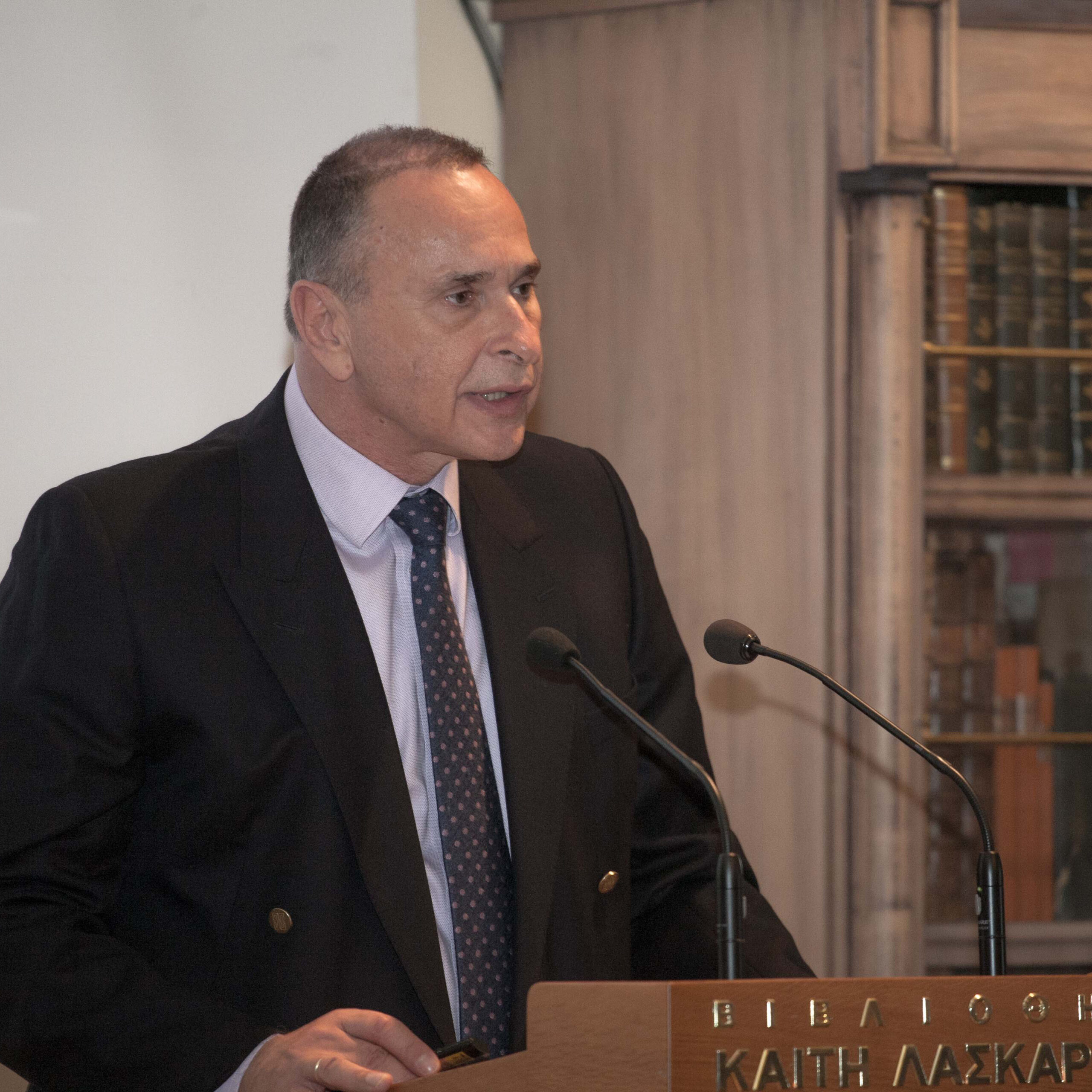
Athanasios Platias is Professor of Strategy at the University of Piraeus, the President of the Council for International Relations, Greece, and a coordinator at the Mackinder Forum. He has been a Ford Foundation fellow at Harvard University, a research fellow at Cornell University, and a MacArthur fellow at the Massachusetts Institute of Technology.

Constantinos Koliopoulos is Professor of International Relations and Strategic Studies at the University of Piraeus, and a former Fulbright scholar. He has been a professor in Strategic Studies at the Hellenic National Defence College, and a master of the Greek Chess Federation.
FAQs
Frequently Asked Questions
What is "The Art of Strategy" about?
From politicians seeking re-election, to statespeople craving spheres of influence, to business executives, military generals and sports coaches, we all employ strategy in our day-to-day activities. Strategic treatises on the art of war, politics or leadership have a long history, including those by Thucydides, Xenophon, Kautilya, Machiavelli and Clausewitz; yet, while recent decades have seen the proliferation of books on business strategy, there has still been no single volume, ancient or modern, combining all strands of the human strategic experience—until now.
The Art of Strategy encapsulates and conveys the logic of strategy in easily accessible prose, and applies it to virtually every form of human endeavour. It builds upon the existing strategic wisdom produced by the great masters to present a holistic theory of strategy that is relevant to practice: a sprightly yet sober analysis of fifty maxims, drawing on examples from chess to psychology.
Platias and Koliopoulos offer the reader a guide to strategic behaviour in all areas of life, while at the same time building a comprehensive theory of victory. They provide a framework that helps the reader to understand the nature of strategy, to think strategically, and to act strategically—and successfully.
Who wrote "The Art of Strategy"?
"The Art of Strategy" was written by Athanasios Platias and Constantinos Koliopoulos.
Athanasios Platias is Professor of Strategy at the University of Piraeus, the President of the Council for International Relations, Greece, and a coordinator at the Mackinder Forum. He has been a Ford Foundation fellow at Harvard University, a research fellow at Cornell University, and a MacArthur fellow at the Massachusetts Institute of Technology.
Constantinos Koliopoulos is Professor of International Relations and Strategic Studies at the University of Piraeus, and a former Fulbright scholar. He has been a professor in Strategic Studies at the Hellenic National Defence College, and a master of the Greek Chess Federation.
Related books