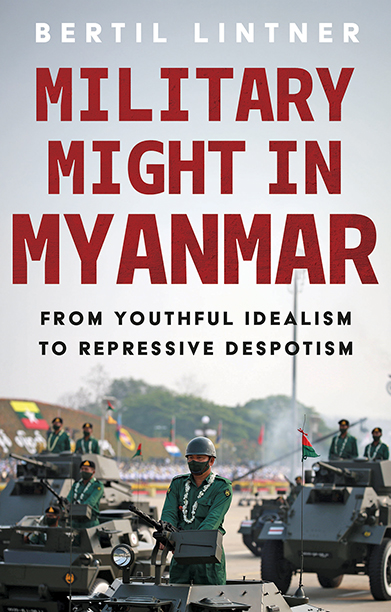
Military Might in Myanmar
From Youthful Idealism to Repressive Despotism
A compelling history, augmented by on-the- ground reporting, of the armed forces of Myanmar, explaining their enduring hold on power.
Description
The longevity of military rule in Myanmar is one of the great enigmas of Asian politics. From 1962 through to the mid-1970s, there were over sixty military takeovers worldwide, the majority involving the overthrow of democratically elected governments. Only one of those military regimes remains in power today: in Myanmar.
Since ousting the elected government in 1962, the Burmese armed forces have encountered several challenges to their solid grip on power, from periodic popular uprisings and ethnic minorities fighting for self-determination to armed resistance movements on the left and right—but this has only entrenched their position. During a decade of relative political openness, from 2011 to 2021, limited space for civilian politicians was created, but direct military rule was reintroduced after a coup in 2021. What is remarkable is that the origins of the current armed forces date back to a meeting of a few young, idealistic nationalists in 1939, who then decided to take up arms against British colonial rule.
Bertil Lintner explores how and why the military developed into a state within a state—and became a repressive institution representing only its narrow self-interests.
Author(s)
Bertil Lintner is an acclaimed journalist and expert on contemporary South-East Asia, especially Myanmar. Formerly the Far Eastern Economic Review’s Burma correspondent, and Asia correspondent for the Swedish daily Svenska Dagbladet, he is the author of, among others, The Costliest Pearl and The Golden Land Ablaze (both published by Hurst).
Related books